

The Complete Guide to Buying a Used Boat in Cleveland: Expert Buyer's Handbook for Lake Erie

The Complete Guide to Buying a Used Boat in Cleveland: Expert Buyer's Handbook for Lake Erie
After 30 years of helping Cleveland boaters navigate purchases on Lake Erie, we've seen the same mistakes repeated by well-intentioned buyers who relied on generic boat-buying advice. This guide is different. It's built specifically for Cleveland buyers, covering everything from hull selection for our conditions to inspecting for freeze damage that only happens in Great Lakes boats.
Whether you're a first-time buyer or upgrading from your starter boat, this handbook will save you from expensive mistakes and help you find a boat that actually works on Lake Erie.
Section 1: Setting Your Budget (The True Cost of Ownership)
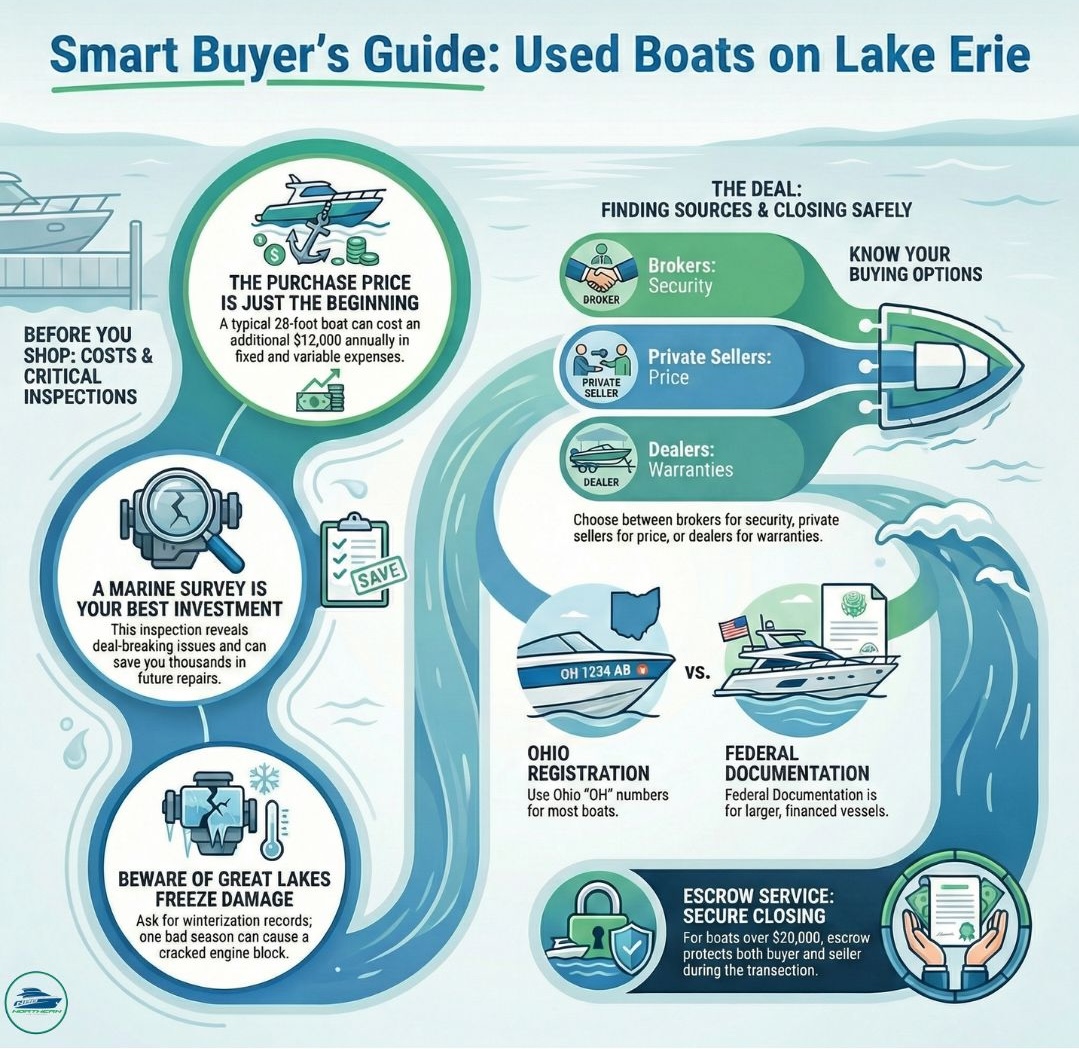
The Purchase Price is Just the Beginning
Most Cleveland boat buyers focus exclusively on the purchase price. That's a mistake. The real question isn't "Can I afford the boat?" It's "Can I afford to own the boat?"
Here's what Lake Erie boat ownership actually costs:
Upfront Costs:
- Purchase price (varies widely)
- Marine survey ($400-$800 depending on size)
- Title transfer and registration ($50-$150)
- Initial insurance premium ($500-$2,000 depending on coverage)
- Immediate repairs/upgrades discovered during survey
Annual Fixed Costs:
- Slip fees at Cleveland marinas ($2,000-$8,000+ seasonally)
- Winter storage ($1,500-$4,000 depending on indoor vs. outdoor)
- Insurance ($800-$3,000 annually)
- Ohio boat registration renewal (typically under $100)
Variable Operating Costs:
- Fuel (budget $200-$800+ per month during season)
- Maintenance and repairs ($1,500-$5,000 annually minimum)
- Spring commissioning ($500-$1,500)
- Fall winterization ($300-$800)
Example: 28-Foot Cruiser on Lake Erie
Purchase price: $45,000
Marine survey: $600
First year slip at Edgewater: $3,500
Winter indoor storage: $2,800
Insurance: $1,200
Fuel (moderate use): $2,400
Maintenance: $2,000
First year total: $57,500
Subsequent years: ~$12,000 annually
If that number makes you uncomfortable, you're looking at too much boat. A good rule: your total annual ownership costs should not exceed 20-25% of the boat's value.
Financing Realities
Unlike car loans, marine financing requires stronger credit and larger down payments. Most lenders want:
- 10-20% down payment minimum
- Credit score of 700+ for best rates
- Terms typically 10-20 years depending on boat value
- Interest rates currently 7-10% (as of early 2025)
For detailed guidance on marine loans, qualification requirements, and working with lenders who understand Great Lakes boats, read our complete guide to boat financing and ownership costs.
Pro Tip: Get pre-approved before you start shopping. It gives you negotiating power and prevents you from falling in love with a boat you can't finance.
Section 2: Choosing the Right Boat Type for Lake Erie
Why Lake Erie is Different
Lake Erie is the shallowest Great Lake, averaging only 62 feet deep with large areas under 30 feet. This creates conditions that are radically different from deeper lakes or coastal waters:
The Lake Erie Reality:
- Waves build quickly in shallow water, creating steep, closely-spaced chop
- Water temperature swings from the 30s in winter to the 70s in summer
- Average wave height on rough days: 3-5 feet, but waves are closer together than ocean swells
- Debris and floating logs are common, especially after storms
- Many Cleveland marinas have depth restrictions (12-15 feet at low water)
What This Means for Boat Selection:
Not every boat is built for these conditions. Here's what works—and what doesn't—on Lake Erie:
Hull Types That Excel on Lake Erie
Deep-V Hulls (Deadrise 18-24 degrees)
Best for: Serious cruisers, anglers who go out in less-than-perfect conditions
Why they work: Deep-V hulls cut through Lake Erie's chop rather than pounding over it. The sharper entry softens the ride in 3-4 foot seas.
Examples: Sea Ray Sundancers, Tiara yachts, Formula cruisers, most center consoles
Trade-off: Burns more fuel, less stable at rest
Modified-V Hulls (Deadrise 14-18 degrees)
Best for: Weekend cruisers, families, versatile use
Why they work: Balance between rough-water capability and efficiency. Handles 2-3 foot chop reasonably well without the fuel penalty of deep-V.
Examples: Chaparral Signature series, Cobalt cruisers, Four Winns Vista
Trade-off: Moderate ride quality in rough conditions
Pontoon Boats
Best for: Protected waters, island hopping, calm-day cruising
Why they work: Excellent stability, spacious, economical
Where they struggle: Rough water. Pontoons pound in 3+ foot chop. Stick to Sandusky Bay, protected marina areas, and calm days on the main lake.
Trade-off: Not a rough-water boat
Hull Types to Avoid (or Use Carefully)
Flat-Bottom Boats
Jon boats, some small fishing boats. These are dangerous on Lake Erie's open water. Period. Reserve these for rivers and protected harbors only.
Cathedral Hulls
Common on older 1980s-90s bow riders. Terrible in chop. They pound like a jackhammer in anything over 2 feet.
Draft Considerations
Many Cleveland-area marinas have depth restrictions. If you're keeping your boat at:
- Edgewater Marina: 8-foot draft maximum, but shallower areas exist
- Cleveland Yachting Club: Similar restrictions
- Whiskey Island Marina: Check current depths
- Sandusky area marinas: Generally deeper, more forgiving
A boat with 4+ feet of draft limits where you can keep it and where you can safely navigate. For most Cleveland recreational boaters, staying under 3.5 feet of draft keeps more options open.
For detailed information on slip availability, amenities, and depth restrictions at local marinas, see our complete Cleveland marina guide.
Size Recommendations by Use
First-Time Buyers: 20-26 feet. Large enough to handle Lake Erie, small enough to learn on, affordable to maintain.
Weekend Cruisers/Families: 26-32 feet. Sweet spot for overnighting, entertaining, handling rough water.
Serious Cruisers: 32-45 feet. For extended trips, Great Loop preparation, or winter trips south.
Fishing Focus: 22-28 foot center consoles or walkarounds. Deep-V hull mandatory for early/late season walleye fishing.
Section 3: Where to Find Used Boats in Cleveland
The Three Main Sources
1. Professional Boat Brokers
Advantages:
- Pre-screened inventory (brokers turn away junk)
- Professional handling of paperwork, title, escrow
- Established relationships with marine surveyors
- Someone to hold accountable if issues arise
- Often have boats stored and winterized properly
Disadvantages:
- Commission built into price (typically 10%)
- Smaller inventory than private market
When to use: When you want professional representation, proper paperwork, and peace of mind. Especially valuable for first-time buyers or boats over $30,000.
Our boat buyer representation service handles everything from finding boats that match your criteria to coordinating surveys, negotiating, and managing the closing process—all at no cost to you as the buyer (seller pays commission).
2. Private Party Sales
Advantages:
- Often better prices (no broker commission)
- Direct negotiation with owner
- Can learn maintenance history firsthand
Disadvantages:
- You handle all paperwork yourself
- Higher risk of undisclosed problems
- More scams and time-wasters
- You coordinate survey, title, payment
Where to look:
- Facebook Marketplace (huge inventory, quality varies)
- Craigslist (still active for boats)
- BoatTrader.com (mix of broker and private listings)
- Local marina bulletin boards
Red flags in private sales:
- "No survey needed, I'm honest"
- Pressure to skip survey or "just use my surveyor buddy"
- Vague answers about maintenance history
- Won't let you see the boat running on water
- Price seems too good to be true
3. Boat Dealers (New/Used)
Advantages:
- Trade-in boats often well-maintained
- Dealer warranty options sometimes available
- Established businesses with reputation to protect
Disadvantages:
- Higher prices than private market
- May prioritize selling new boats
When to use: When you want a newer used boat (2-5 years old) with some warranty protection.
The Northern Boat Brokerage Difference
As Cleveland's riverfront boat brokerage, we offer something different than typical dealers or private sales: local expertise combined with professional service.
What sets us apart:
- 30+ years of Lake Erie market knowledge
- Personal relationships with local marinas, surveyors, and mechanics
- We only represent boats we'd personally recommend
- Full-service support from search to closing
- Buyer representation at no cost to you
Learn more about what to expect when working with a professional boat broker.
Section 4: The Pre-Purchase Inspection Process
What a Marine Survey Actually Is
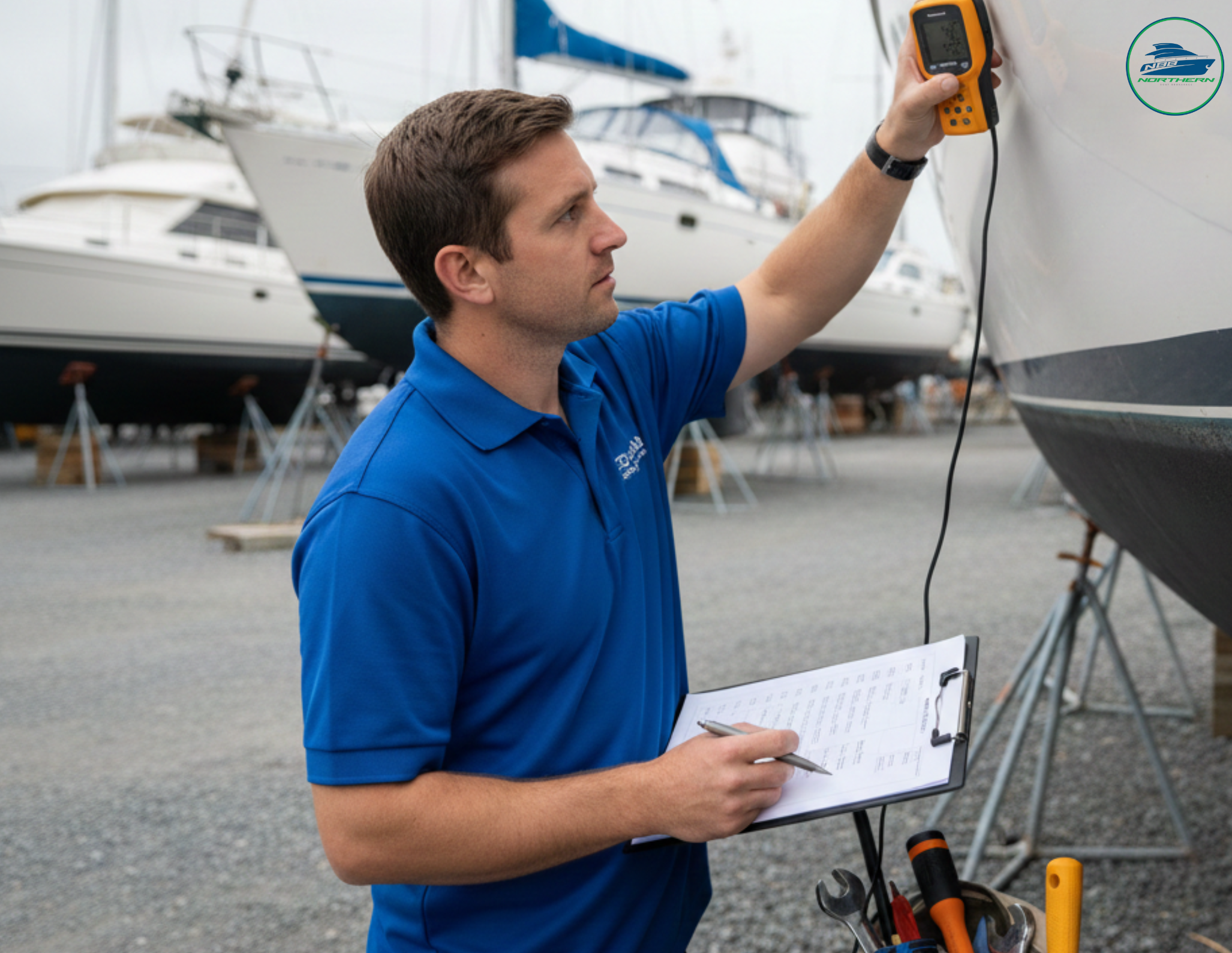
A marine survey is not a mechanic's inspection. It's a comprehensive examination of the boat's structural integrity, systems, and safety equipment performed by a certified marine surveyor.
What surveyors examine:
Structural:
- Hull integrity (fiberglass, gelcoat, core materials)
- Deck and cockpit condition
- Through-hull fittings and seacocks
- Transom soundness (critical on older boats)
- Stringers and structural supports
Mechanical:
- Engine compression test
- Oil analysis
- Cooling system inspection
- Transmission and outdrive condition
- Fuel system integrity
Electrical:
- Wiring condition and compliance
- Battery and charging system
- Bonding and grounding
- Navigation lights and electronics
Safety:
- Fire suppression system
- Bilge pumps and float switches
- Navigation equipment
- Safety gear compliance
Lake Erie-Specific Inspection Concerns
Freeze Damage
This is unique to Great Lakes boats and often missed by surveyors from warmer climates. Freeze damage occurs when water isn't properly drained from:
- Engine blocks and manifolds
- Freshwater systems
- Air conditioning systems
- Livewells and washdown pumps
What to look for:
- Cracked engine blocks (often not visible until surveyed)
- Split manifolds
- Cracked water heaters
- Burst plumbing lines
Questions to ask the seller:
- "Who performed your winterization and where?"
- "Do you have receipts for winterization service?"
- "Has the boat ever been stored outdoors in winter?"
Outdoor winter storage isn't automatically bad—many Cleveland boats survive it fine—but it increases freeze risk if winterization wasn't thorough.
Trailer Deterioration
Cleveland boats often sit on trailers during winter. Unlike boats kept in the water year-round, our boats experience:
- Road salt exposure during transport
- Freeze/thaw cycles on tires and bearings
- Weight stress on hull during months of storage
Even if the boat is perfect, a deteriorated trailer can add $2,000-$5,000 to your costs.
Check:
- Frame rust and structural integrity
- Tire age (replace if over 5 years regardless of tread)
- Bearing and hub condition
- Wiring and lights
- Winch operation
The Survey Process
1. Schedule the Survey
Do this AFTER you've agreed on price but BEFORE money exchanges. Include a survey contingency in your purchase agreement.
Typical language: "Purchase contingent upon satisfactory marine survey at buyer's expense. Buyer has 10 days to complete survey and may cancel for any reason within that period."
2. Survey Day
Plan for 3-5 hours depending on boat size. You should attend if possible—you'll learn about the boat's systems and can ask questions.
The surveyor will:
- Examine the boat out of water (if possible)
- Test all systems
- Run the engine under load
- Provide detailed notes and photos
3. Receiving the Report
You'll get a 15-30 page report within 3-5 days covering:
- Overall condition rating
- List of deficiencies (safety-critical vs. cosmetic)
- Estimated repair costs
- Recommendations for further specialist inspection (if needed)
- Fair market value opinion
How to Use Survey Results
If the survey is clean: Proceed to closing.
If minor issues are found ($500-$2,000 in repairs):
- Negotiate a price reduction
- Ask seller to make repairs before closing
- Accept as-is if price already reflected condition
If major issues are found ($5,000+):
- Renegotiate price significantly
- Walk away if seller won't negotiate
- Get specialist opinions (like an engine surveyor for suspected engine problems)
Red flags that mean "walk away":
- Delamination (hull-to-deck separation)
- Soft deck cores from water intrusion
- Cracked engine blocks or major freeze damage
- Extensive electrical problems
- Serious transom rot
Survey Costs
- Boats under 30 feet: $400-$600
- Boats 30-40 feet: $600-$800
- Boats over 40 feet: $800-$1,200+
Is it worth it? Always. A survey will either:
- Confirm the boat is sound (peace of mind)
- Identify problems you can negotiate on (saves money)
- Reveal deal-breakers before you commit (saves you from disaster)
We've seen buyers save $10,000+ in negotiated price reductions based on survey findings. The $600 survey fee pays for itself many times over.
Section 5: Understanding Boat Documentation vs. Ohio Registration
Before you finalize your purchase, you need to understand how the boat will be titled and registered. This affects insurance, financing, and future resale.
The Two Systems
Ohio State Registration (Most Common)
For boats registered with the Ohio Division of Watercraft:
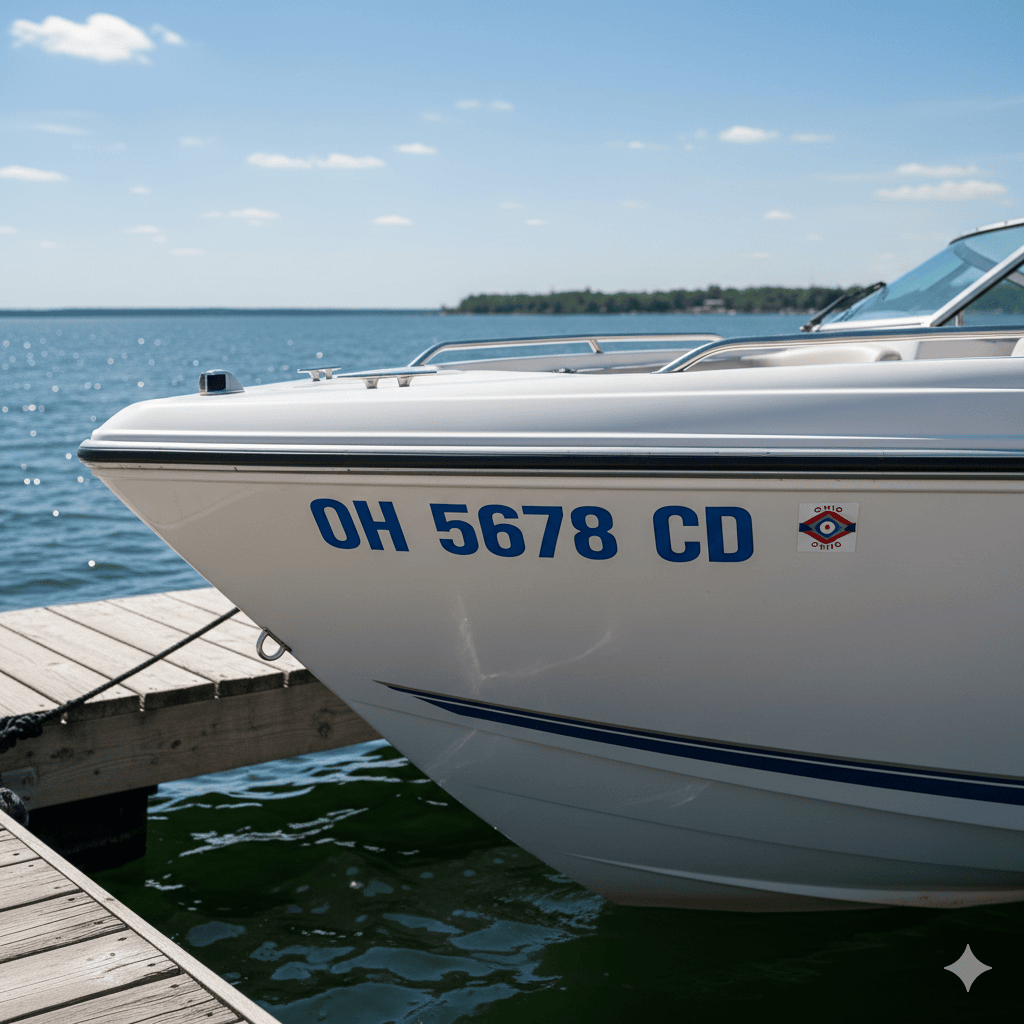
- Displays "OH" numbers on the bow
- Registration sticker on port side
- Renewed annually
- Managed by Ohio BWC
Federal Documentation (USCG)
For boats documented with the U.S. Coast Guard:
- No bow numbers required
- Must display vessel name and hailing port on the stern
- Renewed annually with USCG
- Provides certain legal advantages
Which is Right for You?
Choose Ohio Registration if:
- Your boat is under 26 feet
- You'll stay on Lake Erie and inland waters
- You want simpler, lower-cost paperwork
- You don't plan to take out a preferred ship mortgage
Choose Federal Documentation if:
- Your boat is 26+ feet and eligible
- You're financing and lender requires it
- You plan to cruise extensively or go offshore
- You want the title benefits for resale
For a complete breakdown of eligibility, costs, pros/cons, and step-by-step processes for both systems, read our detailed guide to boat documentation vs. Ohio registration.
Transfer Process
When buying a used boat:
If currently Ohio-registered:
- Seller signs over title
- You submit paperwork to Ohio BWC
- Pay sales tax (5.75% in Ohio, credit for tax paid in other states)
- Receive new registration
If currently federally documented:
- Seller provides Bill of Sale
- You file transfer with USCG (National Vessel Documentation Center)
- More complex process, often requires professional help
Our title and registration assistance service handles the entire process for you, ensuring paperwork is correct and filed promptly.
Section 6: Negotiation Strategies
Know the Market
Before you make an offer, research comparable sales. Use:
- NADA Guides (marine values)
- BUC (Soldboats database)
- Recent sold listings on BoatTrader
- Local broker insights
Cleveland's market has unique seasonal patterns:
- Spring rush (April-May): Prices peak as inventory moves
- Summer (June-August): Steady market, less urgency
- Fall (September-October): Motivated sellers trying to avoid winter storage costs
- Winter (November-March): Best buyer's market, lowest prices
Negotiation leverage increases with:
- Survey findings showing needed repairs
- Boat sitting unsold for 90+ days
- Motivated seller (relocation, financial pressure, avoiding storage costs)
- Off-season purchase
Starting Your Offer
For boats in good condition, priced fairly: Start at 90-95% of asking price.
For boats with known issues or priced high: Start at 80-85% of asking price.
For boats sitting 6+ months: Start at 75-80% of asking price.
What to Negotiate Beyond Price
- Included equipment: Trailer, electronics, safety gear, winter cover
- Repairs: "Seller to repair X before closing" or "reduce price by $Y to cover repairs"
- Closing timeline: Faster closing can be valuable to motivated sellers
- Delivery: Will seller deliver to your marina?
When to Walk Away
Don't fall victim to "deal fever"—the emotional attachment that makes you overpay.
Walk away if:
- Seller won't allow pre-purchase survey
- Survey reveals major structural issues seller won't address
- Seller misrepresented condition (undisclosed damage)
- You're stretching beyond your budget
- Your gut says something is wrong
There are always more boats. Don't compromise on a major purchase because you "fell in love" with the wrong boat.
Section 7: Closing the Deal Safely
Escrow is Your Friend
For boats over $20,000, use a marine escrow service. It protects both parties:
How it works:
- Buyer deposits funds with escrow company
- Seller provides clear title and bill of sale
- Boat is surveyed and delivered
- Escrow releases funds to seller once buyer confirms receipt
- Title transfer is completed
Cost: Typically $200-$500 depending on transaction size. Worth every penny.
Cleveland-area escrow services:
- Boat Escrow LLC
- First American Title (marine division)
- Local marine-focused title companies
Payment Methods
Safe:
- Escrow service
- Cashier's check (verify with bank before handing over)
- Wire transfer through escrow
- Marine lender direct payment
Risky:
- Cash (no paper trail)
- Personal checks (can bounce)
- Payment before receiving title
Documentation Checklist
Before money changes hands, ensure you have:
- Signed Bill of Sale
- Clear title (Ohio) or Abstract of Title (USCG documented)
- Lien release if applicable (see below)
- Survey report
- Ownership transfer forms completed
- Sales tax documentation
- Keys and access codes
- Owner's manuals and service records
- Equipment inventory list
Buying a Boat with a Lien
Many used boats still have outstanding loans. This isn't necessarily a problem, but it must be handled correctly.
The process:
- Verify lien with lender (seller provides contact info)
- Get exact payoff amount in writing
- Use escrow to pay off lien holder directly
- Lender releases lien and provides satisfaction of lien document
- Remaining funds (if any) go to seller
Never:
- Pay seller directly when a lien exists
- Trust seller to "pay off the loan" after you pay them
- Accept a title with an unreleased lien
For detailed guidance on buying or selling boats with liens, read our complete guide to selling financed boats and lien payoffs.
Sea Trial (Final Step)
Always do a final on-water test before closing, even if you surveyed the boat earlier:
Test:
- Engine starts easily (cold start and warm start)
- All electronics function
- No unusual vibrations or noises
- Steering is smooth
- Boat performs as expected
This is your last chance to uncover problems. If something feels wrong, don't close until it's resolved.
Section 8: First 30 Days of Ownership
Insurance (Get This Before You Leave the Dock)
Many new owners forget that insurance is required before you can legally operate the boat or keep it at most marinas.
What you need:
- Liability coverage (minimum $300,000)
- Physical damage coverage (if financed, lender requires this)
- Uninsured boater coverage (recommended for Lake Erie)
- Towing and assistance coverage (optional but valuable)
Cleveland-specific considerations:
- Hurricane haul-out coverage (yes, Lake Erie gets hurricane remnants)
- Winter storage coverage
- Agreed value vs. actual cash value
For complete details on marine insurance types, coverage limits, and what Cleveland boaters actually need, read our comprehensive boat insurance guide.
Finding a Slip or Storage
If you didn't secure a marina slip before buying, do it immediately. Cleveland slips fill up fast in spring.
Top Cleveland-area marinas:
- Edgewater Yacht Club
- Cleveland Yachting Club
- North Coast Harbor
- Whiskey Island Marina
- Sandusky area marinas (if you're willing to drive)
What to ask:
- Current slip availability and waiting list
- Seasonal vs. transient rates
- Amenities (pump-out, electricity, water, WiFi)
- Winter storage options and costs
- Haul-out and launch fees
See our complete Cleveland marina guide for detailed reviews of local marinas, slip costs, and amenities.
Registration and Title Transfer
Timeline:
Ohio requires you to transfer title within 60 days of purchase. Budget 2-4 weeks for processing.
Process:
- Submit completed ownership transfer application
- Provide bill of sale
- Pay sales tax (5.75% on purchase price)
- Pay registration fees
- Receive new registration and title
Need help navigating the paperwork? Our title and registration service handles everything for you.
Essential First Maintenance
Immediate (before first use):
- Verify all safety equipment (life jackets, fire extinguisher, flares)
- Check engine oil and coolant levels
- Inspect bilge pumps and float switches
- Test all electrical systems
- Verify navigation lights work
First Month:
- Change engine oil (even if seller says it was just done)
- Replace fuel filters
- Inspect and service outdrive or outboard
- Check/replace impeller if due
- Have a mobile mechanic give it a once-over
Before Your First Lake Erie Trip:
- Install/update marine electronics (GPS, depth finder)
- Load emergency equipment (anchor, toolkit, spare parts)
- Create a float plan system
- Join BoatUS or similar towing service
Section 9: Common Mistakes Cleveland Boat Buyers Make
Mistake #1: Buying Too Much Boat
The problem: First-time buyers often buy the largest boat they can afford, then realize they can't afford to operate it.
The reality: Operating costs scale with size. A 40-foot cruiser might cost 3x more annually than a 28-footer, even though the purchase price was only 2x higher.
The fix: Start smaller than you think you need. Most boaters upgrade every 5-7 years anyway.
Mistake #2: Ignoring Winterization History
The problem: Buyers from warmer climates don't ask about freeze damage because it's not on their radar.
The reality: One bad winterization can cause $10,000+ in engine damage that isn't visible until the engine is run under load.
The fix: Demand winterization records. If seller can't provide them, factor potential freeze damage into your offer price.
Mistake #3: Skipping the Survey
The problem: "The boat looks good to me" or "the seller seems honest" or "it's only $15,000."
The reality: Sellers lie. Boats hide problems. Always survey.
The fix: Make survey contingent part of every purchase agreement. No exceptions.
Mistake #4: Emotional Buying
The problem: Falling in love with the first boat you see and overpaying because "it's perfect."
The reality: There are thousands of boats for sale. The perfect boat is the one that meets your needs at a fair price—not the first shiny thing you see.
The fix: Look at 5-10 boats before making an offer on anything. Get comps. Be patient.
Mistake #5: Not Budgeting for Immediate Repairs
The problem: Spending your entire budget on the purchase price, then discovering you need $3,000 in immediate repairs just to make the boat safe.
The reality: Most used boats need something. Budget 10-15% of purchase price for first-year repairs and upgrades.
The fix: If your budget is $30,000, shop for boats around $25,000 so you have cushion for repairs.
Mistake #6: Buying the Wrong Boat for Lake Erie
The problem: Buying a boat designed for calm inland lakes or coastal cruising, then discovering it's miserable on Lake Erie.
The reality: Flat-bottom boats, cathedral hulls, and shallow-V hulls pound brutally in Lake Erie chop.
The fix: Test the boat on Lake Erie in 2-3 foot seas before committing. If the seller won't allow this, walk away.
Section 10: Why Work with Northern Boat Brokerage
We've covered a lot of ground in this guide, and if you're feeling overwhelmed, that's normal. Buying a boat—especially your first boat—is a complex process with financial and safety stakes.
Here's what we do differently:
Local Lake Erie Expertise
We've been on Lake Erie for 30+ years. We know:
- Which hull designs actually work in our conditions
- Which local marinas have availability (and which have 3-year waiting lists)
- Which marine surveyors are thorough vs. rubber-stamp artists
- Which boats are known for problems on the Great Lakes
- Where to find the best service and repair facilities
This isn't generic boating knowledge—it's Cleveland-specific, Lake Erie-specific expertise you can't get from a national brokerage or out-of-state broker.
Full-Service Buyer Representation
Our boat buyer service isn't just "let me show you what's for sale." We:
- Define your actual needs (not just wants) based on how you'll use the boat
- Search inventory beyond just our listings
- Coordinate surveys with trusted local surveyors
- Negotiate on your behalf
- Manage all paperwork, title, and registration
- Connect you with financing, insurance, and marina contacts
And here's the best part: This service is free to buyers. The seller pays our commission, not you.
Honest Guidance
We turn away boats with hidden problems. We tell buyers when they're looking at too much boat or the wrong type of boat for their needs.
Why? Because our reputation in the Cleveland boating community matters more than any single commission. We're the local guys—you're going to see us at the marina, the boat show, and on the water. We protect that reputation fiercely.
Proven Track Record
We've helped hundreds of Cleveland boaters find the right boat. We've prevented countless bad purchases. We've negotiated tens of thousands in price reductions based on survey findings.
More importantly: our clients stay clients. They come back when they're ready to upgrade. They send their friends. They trust us because we've earned it.
Conclusion: Your Next Steps
Buying a used boat in Cleveland doesn't have to be stressful or risky. Armed with this guide, you now know:
- How to budget for true ownership costs
- Which hull types work on Lake Erie (and which don't)
- Where to find boats and how to evaluate sources
- What a proper marine survey includes—and why freeze damage matters here
- How to negotiate effectively
- How to close safely
- What to do in your first 30 days of ownership
If you're ready to start shopping:
- Set your realistic budget (purchase + first-year costs)
- Define your must-haves vs. nice-to-haves
- Review current inventory on our listings page
- Contact us for buyer representation—we'll find boats that match your criteria, even if we don't currently have them listed
If you're still researching:
That's smart. Take your time. Read our other guides:
- Boat financing and ownership costs
- Boat documentation vs. Ohio registration
- Cleveland marina guide
- What to expect from a boat broker
Have questions this guide didn't answer?
Call us at (216) 780-5988 or send us a message. We're happy to talk through your specific situation—no obligation, no pressure.
We've been helping Cleveland boaters for three decades. Let us help you find the right boat for Lake Erie.
About Northern Boat Brokerage
Northern Boat Brokerage is Cleveland's trusted riverfront boat brokerage, specializing in helping Lake Erie boaters buy and sell boats since the 1990s. Located at 2814 Detroit Ave in Cleveland, we combine local expertise with professional service to make boat ownership easy and enjoyable.
Services:
- Full-Service Brokerage for sellers
- Boat Buyer Representation (free to buyers)
- Title & Registration Assistance
- Storage & Winterization Referrals
Contact us today: (216) 780-5988