

How to Sell a Boat with a Lien: A Complete Guide for Cleveland Boat Owners

How to Sell a Boat with a Lien: A Complete Guide for Cleveland Boat Owners
You've decided it's time to sell your boat, but there's one complication: you still owe money on it. The lien holder (your bank or marine lender) technically owns the boat until you pay it off, which makes the selling process trickier.
But here's the good news: selling a boat with a lien is completely doable. We help Lake Erie boaters navigate lien payoffs all the time. It just requires some extra paperwork and coordination.
Here's everything you need to know about selling your boat when there's still a loan attached.
What Is a Lien, and Why Does It Matter?
A lien is a legal claim against your boat by the lender who financed your purchase. It means the lender has a security interest in the vessel until the loan is paid in full. The lien is recorded on your boat's title—similar to a car loan.
You cannot legally transfer ownership of a boat with a lien unless:
- The lien is paid off in full, OR
- The buyer agrees to assume the loan (rare and complicated)
Most buyers want a clean title with no encumbrances, which means you'll need to satisfy the lien before or during the sale.
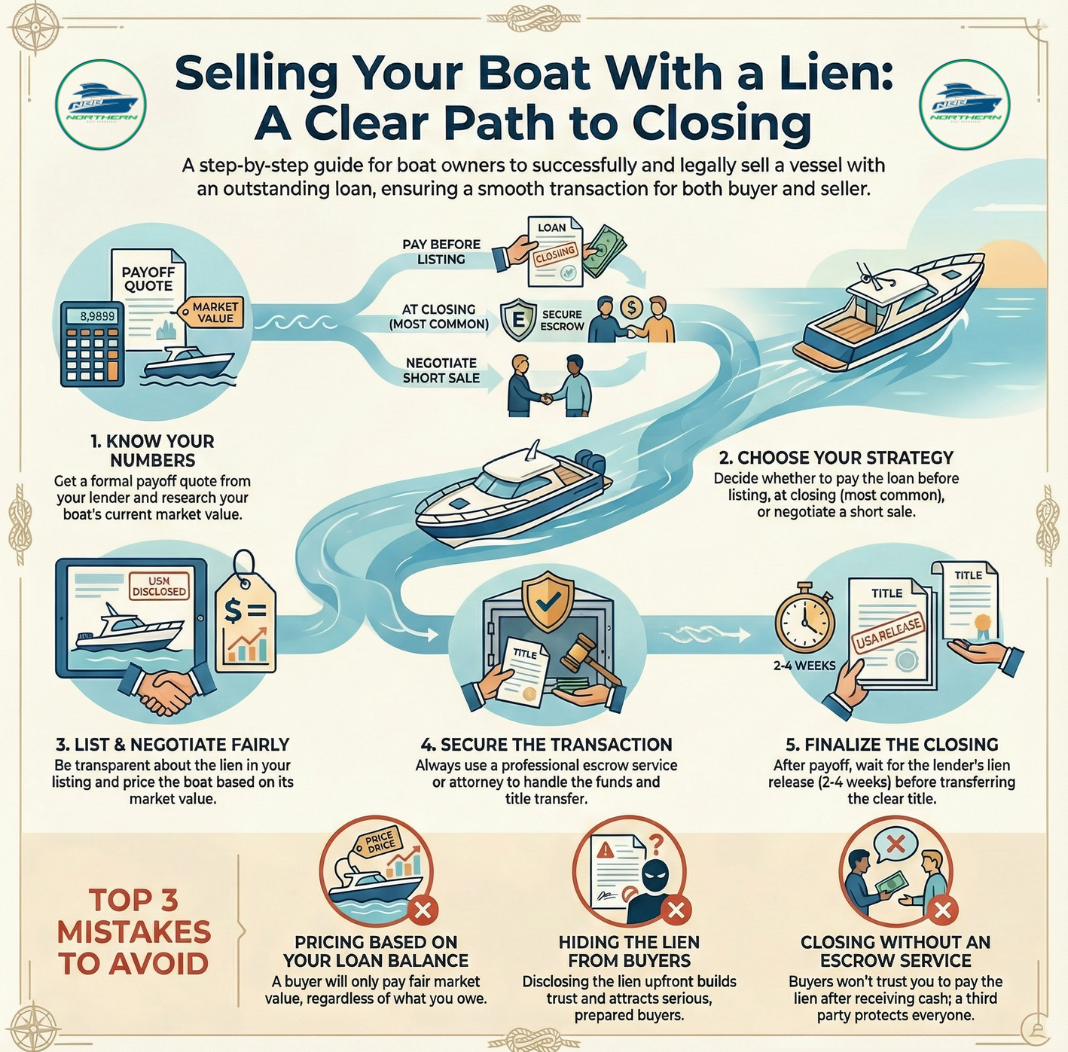
Step 1: Find Out Your Payoff Amount
Before you list your boat, contact your lender and ask for a payoff quote. This is the exact amount needed to satisfy the loan and release the lien.
Important details to get:
- Current payoff amount
- Per diem interest (how much interest accrues daily)
- Payoff good-through date (typically 10-30 days)
- Where to send the payoff funds (wire instructions, mailing address)
- How long it takes to process the lien release (can be 2-6 weeks)
Pro tip: Get this in writing via email or a formal payoff statement. You'll need it for closing.
Step 2: Compare Payoff Amount to Market Value
Now you need to know: is your boat worth more than you owe, or are you underwater?
Scenario A: Positive Equity (Boat value > Loan balance) Let's say you owe $45,000 but the boat is worth $60,000. You have $15,000 in equity. This is the easy scenario—the buyer's payment covers your loan payoff, and you pocket the difference.
Scenario B: Negative Equity / Underwater (Boat value < Loan balance) You owe $50,000, but the boat is only worth $42,000. You're $8,000 underwater. You'll need to bring cash to closing to cover the difference, or negotiate with the lender (more on this below).
How to determine market value:
- Check recent sold listings on boat sites (not asking prices—sold prices)
- Use NADA Guides or BUC Book as a baseline
- Get a professional appraisal if you're underwater (helps with lender negotiations)
- Better yet—call us. We'll give you a realistic market assessment for free.
Step 3: Decide on Your Selling Strategy
You have three main options when selling a boat with a lien:
Option 1: Pay Off the Lien Before Listing
If you have cash reserves, the cleanest approach is to pay off the loan upfront, get the lien released, and then sell with a clear title.
Pros:
- Simplest transaction for buyers
- Faster closing process
- More negotiating power (buyers love clean titles)
Cons:
- Requires liquid cash on hand
- You're tying up money until the sale closes
Best for: Sellers with positive equity and available cash reserves.
Option 2: Pay Off at Closing (Escrow)
This is the most common method. The buyer's payment goes into escrow, the lien is paid off from escrow funds, and the title is transferred once the lien release is received.
How it works:
- Buyer and seller agree on price
- Buyer deposits funds with escrow company or closing attorney
- Escrow sends payoff directly to lender
- Lender releases lien and sends clear title
- Title is transferred to buyer
- Remaining funds (if any) go to seller
Pros:
- No upfront cash needed from seller
- Protects both parties
- Standard practice in marine transactions
Cons:
- Adds 2-4 weeks to closing (waiting for lien release)
- Requires escrow fees ($300-$800 typically)
- Buyer needs to be patient
Best for: Most sellers with liens. This is the standard approach.
Option 3: Negotiate a Short Sale with Your Lender
If you're underwater and can't bring cash to closing, you may be able to negotiate a short sale—where the lender agrees to accept less than the full payoff amount.
Example: You owe $50,000, the boat is worth $42,000, and you can't come up with the $8,000 difference. You ask the lender to accept $42,000 as full payment and forgive the remaining $8,000.
Lender considerations:
- Is the borrower in financial hardship?
- How much would the lender lose in repossession and resale?
- Is the boat's condition declining (making it worth less if they repo)?
Pros:
- Avoids bringing cash to closing
- Avoids defaulting or repossession
Cons:
- Damages your credit (shows as "settled for less than owed")
- Not all lenders will agree
- Requires extensive documentation and negotiation
Best for: Sellers who are underwater and facing financial hardship.
Step 4: List Your Boat (Be Transparent About the Lien)
Some sellers try to hide the lien until closing. Don't do this. It kills trust and can blow up deals.
In your listing, disclose:
- "Boat has a lien that will be satisfied at closing via escrow"
- Approximate payoff amount (optional, but shows transparency)
- Your willingness to work with escrow or a closing attorney
Why transparency works:
- Serious buyers understand liens are normal
- Shows you're professional and organized
- Attracts buyers who are ready to close properly
Step 5: Negotiate the Sale Price
The lien payoff is your problem, not the buyer's. The buyer cares about market value, not what you owe.
Common mistake: "I owe $50,000, so I need to get at least $50,000 for the boat."
Reality: If the boat is worth $45,000, buyers won't pay $50,000 just because you're underwater. You'll either need to bring $5,000 to closing or negotiate a short sale with your lender.
Good approach: Price the boat at fair market value. If you have equity, great. If you're underwater, decide upfront whether you can bring cash or need to pursue a short sale.
Step 6: Use Escrow or a Closing Attorney
Never try to handle a lien payoff without a third party. Too many things can go wrong.
Escrow process:
- Buyer and seller sign purchase agreement
- Buyer deposits full purchase price into escrow
- Escrow verifies payoff amount with lender
- Escrow wires payoff directly to lender
- Lender releases lien and mails title to escrow
- Escrow transfers clean title to buyer
- Escrow releases remaining funds to seller
Cost: $300-$800 depending on transaction size and location.
Where to find escrow:
- Marine-specific escrow companies (Escrow.com, BoatEscrow)
- Local maritime attorneys
- Your boat broker (we coordinate this for clients regularly)
Step 7: Wait for the Lien Release
This is the slow part. After your lender receives payoff, they need to:
- Process the payment (1-3 business days)
- Generate lien release paperwork (1-5 business days)
- Mail the release and clear title (5-10 business days)
Total time: 2-4 weeks on average. Some lenders are faster (USAA, Navy Federal), others are slower (smaller credit unions).
During this time:
- Buyer doesn't take possession
- Boat stays with seller or in secure storage
- Funds stay in escrow
Once title is clear:
- Title transferred to buyer
- Buyer takes possession
- Seller gets paid
Special Considerations for Ohio Boat Owners
Ohio doesn't title boats under 14 feet or without motors, but if your boat is titled, here's what matters:
Ohio lien releases: Your lender files the lien electronically with the Ohio BMV. Once paid off, they submit an electronic lien release. You can verify lien status at any Ohio BMV or online.
USCG documented vessels: If your boat is Coast Guard documented (most boats over 25 feet), the lien is filed with the National Vessel Documentation Center. The process is similar but handled federally, not through Ohio.
What If the Buyer Wants to Assume Your Loan?
Occasionally, a buyer will ask to take over your loan payments instead of getting their own financing. This is called loan assumption.
Why it rarely works:
- Most marine lenders don't allow loan assumptions
- The lender would need to qualify the buyer (credit check, income verification)
- You'd still be liable if the buyer defaults (unless formally released)
Our advice: Don't pursue loan assumption unless the buyer is family or a close friend. It's simpler for the buyer to get their own financing and for you to pay off your lien at closing.
Common Mistakes Boat Sellers Make with Liens
Mistake 1: Not Getting a Payoff Quote Before Listing
You need to know your exact payoff to price the boat correctly. Guessing leads to problems at closing.
Mistake 2: Thinking the Buyer Will Pay What You Owe
Market value is market value. If you're underwater, that's your responsibility to resolve.
Mistake 3: Trying to Close Without Escrow
Buyers won't (and shouldn't) trust you to pay off the lien after they hand you cash. Use escrow.
Mistake 4: Not Communicating with the Buyer About Timeline
Lien releases take time. Set expectations upfront: "Closing will take 3-4 weeks after we agree on price due to lien payoff processing."
Mistake 5: Forgetting About Per Diem Interest
If your payoff quote expires and closing is delayed, you'll owe additional interest. Factor this into your numbers.
How Northern Boat Brokerage Handles Lien Payoffs
We manage lien payoffs for clients all the time. Here's how we make it painless:
Step 1: We contact your lender and get the payoff quote for you.
Step 2: We price your boat at fair market value and disclose the lien in the listing.
Step 3: We pre-qualify buyers to ensure they have financing or cash ready.
Step 4: We coordinate escrow through a trusted marine attorney or escrow service.
Step 5: We manage the timeline and keep all parties informed.
Step 6: We ensure the lien is released and the title is transferred correctly.
You don't touch the paperwork—we handle it.
Real Example: How We Sold a 2015 Sea Ray 350 Sundancer with a Lien
Situation:
- Client owed $125,000 on the boat
- Boat was worth $140,000
- $15,000 in equity
- Wanted to upgrade to a larger cruiser
What we did:
- Got payoff quote from lender: $125,347 (including per diem interest)
- Listed boat at $139,900 (priced aggressively to sell fast)
- Found buyer in 18 days at $137,500
- Buyer deposited $137,500 into escrow
- Escrow wired $125,347 to lender
- Lender released lien in 12 days
- Title transferred to buyer
- Seller received $11,353 (after escrow fees and broker commission)
Total timeline: 35 days from listing to closed deal.
Client's feedback: "I thought the lien would be a nightmare, but Northern handled everything. I just showed up to sign papers."
The Bottom Line: Liens Are Normal, Not a Deal-Breaker
About 40% of boats we sell have liens. It's standard in the marine industry. Buyers expect it, lenders are used to it, and the process is straightforward when you work with professionals.
Key takeaways:
- Get your payoff quote before listing
- Price at market value, not what you owe
- Use escrow or a closing attorney
- Be transparent with buyers about the timeline
- Work with a broker who handles this regularly
If you're ready to sell your boat and need help navigating the lien payoff:
Visit: www.northernboatbrokerage.com
We'll handle the paperwork, coordinate the payoff, and make sure you get top dollar for your boat—lien or no lien.
Let's get your boat sold.